What is a casement window?
A casement window has two separate sets of sashes. Viewed from inside the room, the inner sashes open towards you, while the outer sashes open outwards. The space between them is lined with a timber board known as the window reveal lining.
The opening method distinguishes a casement window from a box window. With a box window, both sets of sashes open into the room. The names are sometimes used interchangeably in everyday speech, so it is better to describe or photograph the actual construction when making an enquiry.
How do casement windows insulate?
The two sets of sashes create an enclosed space between the outer and inner sections of the window. Original casement windows generally had single glazing in both sets of sashes and usually lacked modern seals. A new casement window can preserve the historic proportions and arrangement while incorporating modern glazing and seals.
Thermal and acoustic performance depends on the dimensions, profiles, glazing, airtightness, installation and other details of the specific product. It therefore makes sense to design the window composition for the particular building instead of relying on general values taken from another project.
This also raises a common question about condensation. Condensation on the inside of the glass is usually associated with high indoor humidity and insufficient ventilation. Condensation on the outside may be a natural consequence of effective glazing insulation. Moisture between the panes, however, indicates a problem that should be assessed by a specialist.
Which buildings suit casement windows?
Casement windows make the most sense where they form part of the building’s original architecture. Typical examples include:
- historic apartment buildings,
- Art Nouveau and early twentieth-century villas,
- listed buildings and properties in conservation areas,
- traditional country houses and other vernacular buildings,
- buildings where the original window arrangement and profiles need to be preserved.
For a property in a conservation area, it is advisable to discuss the proposal with the heritage authorities before ordering new windows. The National Heritage Institute points out that the windows, their fittings, arrangement and installation form part of the building’s architectural expression. Only an assessment of the specific property can determine which elements need to be preserved and under what conditions the windows may be replaced.
We mainly specialise in replacing windows throughout apartment buildings and in historic properties. If you chair a homeowners’ association or housing cooperative, or own a building with a large number of windows, we can create a consistent design throughout the property and preserve the unified appearance of the façade.
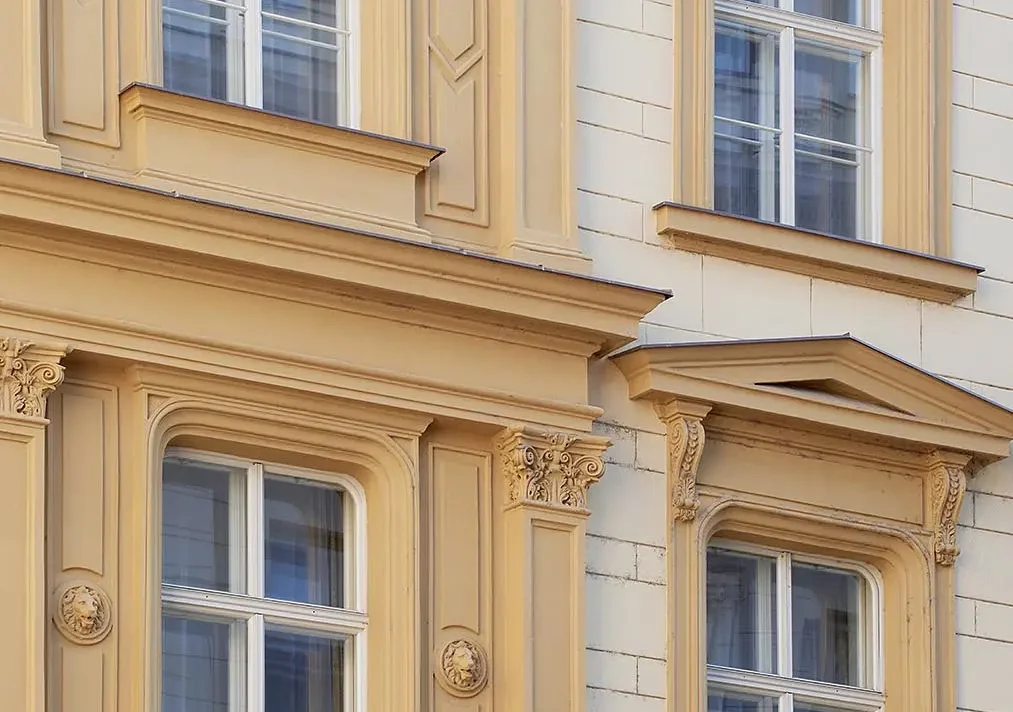
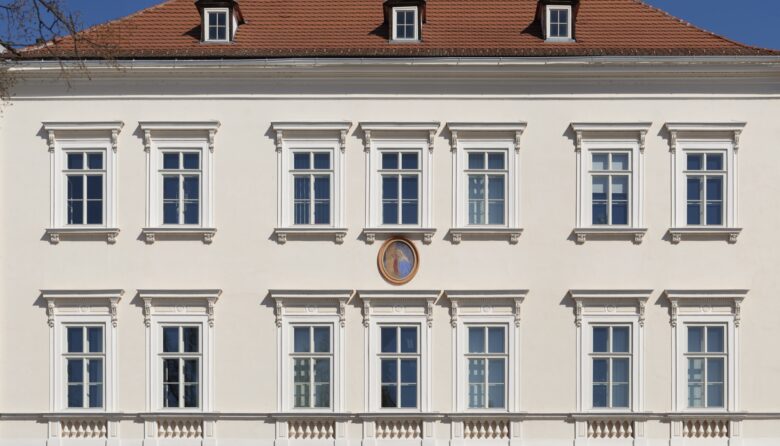
The result can be seen in our project in Gorazdova Street in Prague 2. Only nine of the building’s original fifty windows remained. We documented the decorative elements on the surviving windows and reproduced them in the new ones, restoring a consistent appearance to the façade. The ability to identify and accurately reproduce original details is what determines whether a new window truly belongs in a historic building.
What materials do we use for casement windows?
Pine is our standard timber because it was also commonly used for many historic windows made before 1950. Its resin content makes it more demanding to work with, and sanding in particular requires a significant amount of manual labour.
Oak is the premium option. It is considerably more expensive than pine, so it is selected for projects where there is a structural, historical or aesthetic reason to use it.
When making a historic replica, we first document the original arrangement, profiles and decorative elements. The new window can then accurately reflect the original appearance, including the bases, capitals, fittings and colour. We finish the surface with opaque paint, a translucent stain or hand-painted wood graining, which imitates the natural grain of timber.
We make all our windows at our production facility in Děčín. We combine work on NC machinery with hand sanding, profile finishing, surface treatment and final assembly. This allows us to adapt every detail to the specific building instead of forcing a historic window into a standardised product. By prior arrangement, you can visit the production facility or our showroom in Prague 5.
How are casement windows replaced in an apartment?
We usually schedule window replacement in a single apartment over two days. We normally work from the interior, so scaffolding is not required for a standard replacement.
Before installation, the access route and an area of approximately 1.5 metres in front of the window must be cleared. Our installers protect the route with covering material. They remove the old window and install the new one so that no opening is left uncovered in the apartment overnight.
Once the installation foam has cured, we make good the surrounding masonry, fit any required trim, seal the joints, install the handles and adjust the window. The quotation for the specific project sets out whether window sills, removal of the original elements and other work are included.
How to care for wooden casement windows
Wood responds to changes in humidity. Small cracks can therefore gradually appear in the finish and, without maintenance, allow water to penetrate the timber.
We recommend treating the window surfaces twice a year, ideally in spring and autumn. First wash the frames and sashes. Once dry, apply a cleaning solution followed by a maintenance product that fills small cracks. Do not carry out the treatment in direct sunlight.
During normal use, do not leave objects between the frame and sash that could damage the seals. Close the sashes correctly and clean the glass without sharp tools.
What affects the price of casement windows?
The largest part of the price is not the timber itself, but the labour involved in manufacture. The main factors are:
- the window arrangement and number of sashes,
- the number of glazing bars,
- the complexity of the profiles and decorative elements,
- any non-standard shape,
- a single-colour or two-colour finish,
- the scope of installation and finishing work.
Casement windows therefore do not have a universal price list. For an initial indicative assessment, send us photographs, approximate dimensions and the number of windows, the address of the building and your preferred timescale. We will then provide an indicative price. If it suits you, we will arrange an on-site survey and prepare a detailed quotation.
Frequently asked questions about casement windows
Can the original casement windows simply be fitted with double glazing?
We do not recommend or provide the replacement of the original glass in historic casement windows with insulating double glazing. Double glazing is considerably heavier than the original single glass and fitting it requires a groove to be routed into the sash frame. This can weaken the old sash, while the additional weight also puts more strain on the hinges. Adding seals may extend the useful life of the original window, but it cannot provide the performance of a new product.
Is approval from the heritage authorities required to replace casement windows?
It depends on whether the building is listed or located in a protected area. For such properties, the proposal must be discussed with the relevant heritage authority before manufacture is ordered. We prepare the technical documentation, a sample and other supporting materials and, by agreement, can also handle the specialist communication.
How long does it take to replace the windows in an apartment?
Replacement in a single apartment usually takes two days. The exact process depends on the number and size of the windows, the condition of the structural openings and the extent of the finishing work.
Can a casement window be made in a non-standard shape?
Yes. We make triangular, arched, elliptical and circular windows, as well as combinations of these shapes. The minimum possible curve radius can be a technical limitation and is assessed for the specific design.
View our casement window projects
Before choosing a window manufacturer for an entire building, look at its completed projects and the quality of its detailing. You can see our work among our references. By prior arrangement, you can also view different designs, colours and types of fittings in our Prague 5 showroom.
You do not need a finished project for the initial assessment. Photographs of the original windows, approximate dimensions, the number of units, the building address and your preferred timescale are enough. Send them to us using the contact form.
No two buildings are the same, so the options for manufacture, installation and discussions with the heritage authorities may also differ. This article provides a general overview; we will gladly discuss the specific process with you on site.
 CS
 DE